News
Is Your Speaker Controversial? HLS Wants to Know — and May Send the Bill
Student groups must tell Harvard Law School whether their speakers or events could be “seen by others as controversial.” Across the ideological spectrum, student leaders are questioning what that means and whether a “yes” could leave their groups paying for police.
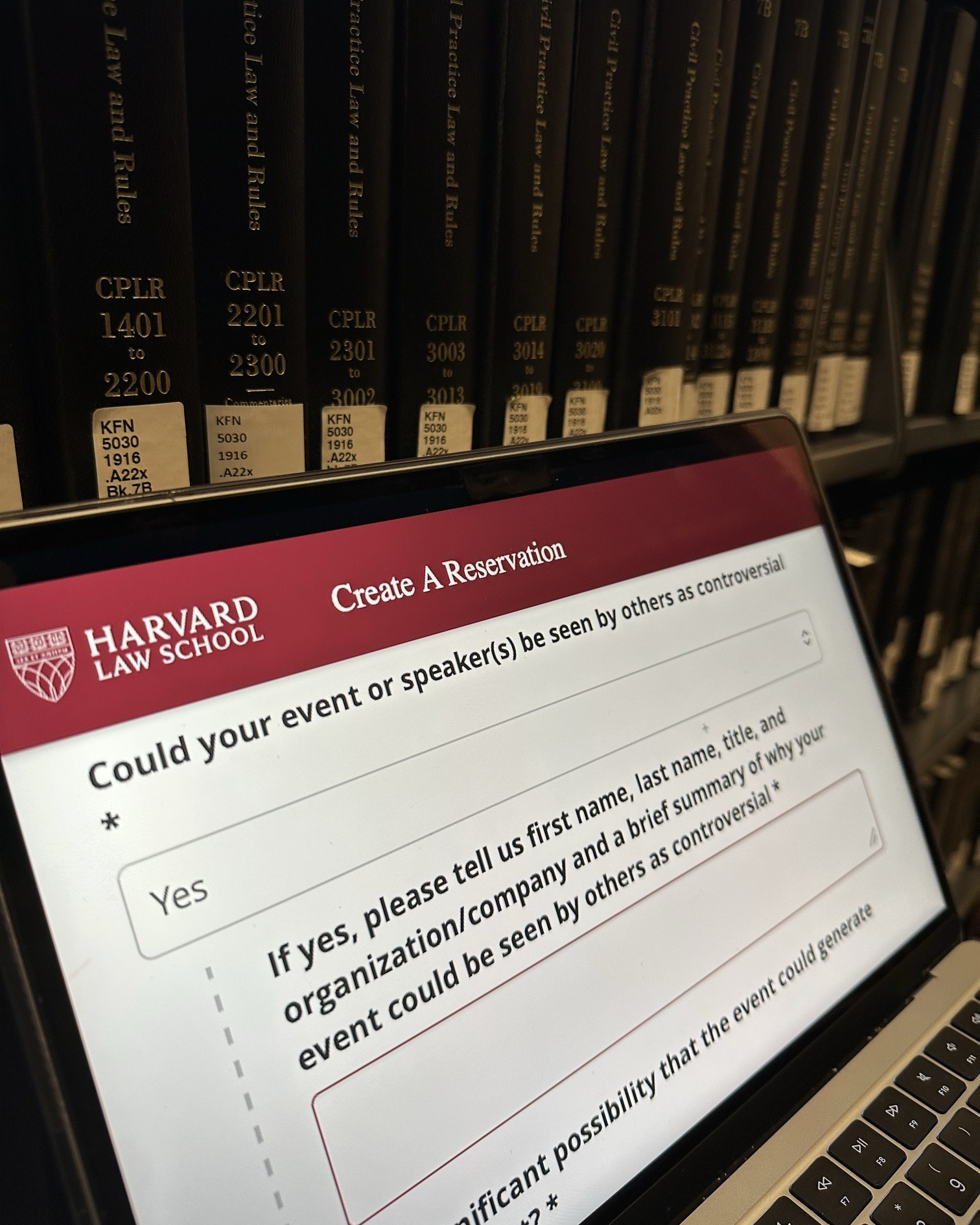
Before a student organization at Harvard Law School can host a speaker on campus, it must answer yes or no: “Could your event or speaker(s) be seen by others as controversial?”
The question, a required field on the school’s event reservation form, is not new. HLS says it dates to 2019. But this fall, student groups are asking what a “yes” actually means.
The form does not define “controversial.” And while it notes elsewhere that HLS may require security at the event sponsor’s expense, it does not say whether a “yes” makes that more likely. Lacey J. Rose, an HLS spokesperson, said that “answering ‘yes’ does not necessarily mean that security is required,” but did not say how the answer factors into the decision to require security or who makes the final call.
Daniel Nivens ’27, president of the Harvard Federalist Society, said the question offers little guidance: “All of our speakers could be seen as controversial. We don’t know what that means.”
For Kayleigh Hasson ’27, co-president of the HLS chapter of the National Lawyers Guild, another concern is the police themselves. “A lot of organizations and students feel less safe in the presence of police,” she said, calling the prospect of making student groups pay for police “despicable.”
The concerns arise as student groups navigate a broader set of HLS rules governing campus expression, from public statements and postings to protests.
The reservation form adds another layer. It asks groups to predict how others will perceive and react to the speakers they invite — and warns that they may have to pay for security.
The Price of a Speaker
Answering “yes” to the controversy question prompts a request for the speaker’s name, title, and affiliation, along with “a brief summary of why your event could be seen by others as controversial.” Next, the form asks whether there is “a significant possibility that the event could generate protest or dissent.” A separate question about whether speakers will come to campus includes a notice: “Harvard Law School may require security based on the event, speakers, or attendance. The event sponsor is responsible for required security costs.” HLS did not specify when the protest question or the cost notice was added to the form.
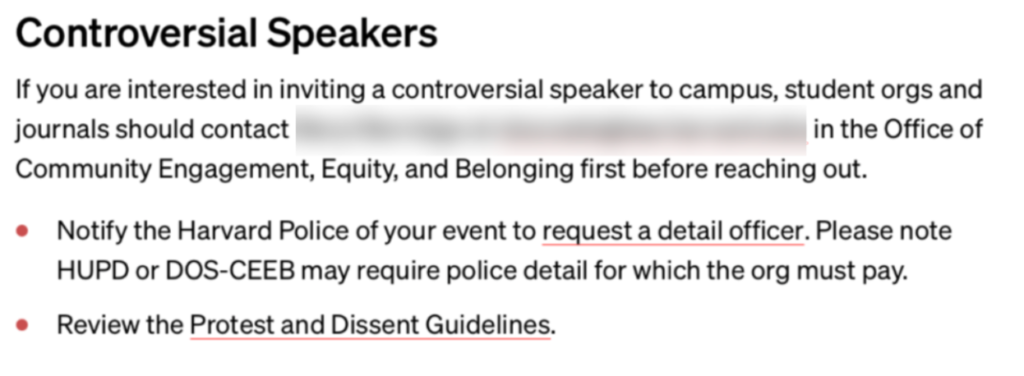
The school’s Speaker Outreach page is more explicit. It instructs groups considering controversial speakers to contact the Dean of Students and Office of Community Engagement, Equity, and Belonging (DOS-CEEB) “first before reaching out,” then notify the Harvard University Police Department (HUPD) “to request a detail officer.” The guidance adds: “Please note HUPD or DOS-CEEB may require police detail for which the org must pay.”
According to HUPD’s published rates, a patrol officer costs $71 an hour, with a four-hour minimum and a 10 percent administrative fee. A one-hour lunch talk requiring one officer would cost a student group $312.40.
The potential expense comes as HLS student organizations face tighter budgets. The school cut student-organization funding by 10 percent for this academic year, The Crimson reported in April. HLS does not publish individual groups’ allocations, but newly recognized groups receive $200 to $250 for their first semester, according to the school — less than the minimum charge for a single patrol officer.
“It’s impossible to plan events without knowing how much it will cost,” said Michael Nevett ’27, a third-year student who serves as co-president of HLS Democrats, “and it’s devastating to consider the impact this policy may have on student organizations’ ability to bring in interesting speakers who shape the political discourse.”
Who Decides?
HLS’s event policies leave unclear who ultimately decides whether security is required — potentially at a student organization’s expense. The event reservation form says “Harvard Law School may require security.” The Speaker Outreach page says HUPD or DOS-CEEB “may require police detail.”
Rose, the HLS spokesperson, said the form asks all event organizers — “whether faculty, staff, departments, student organizations, or journals” — for information that “helps the School plan for security and other event needs.” Security determinations, she said, are based on “several factors outlined on the HLS website.”
But the school’s event guidelines repeat the reservation form’s language, saying security may be required based on “the event, speakers, or attendance.” They do not define “controversial” or explain how the school determines when controversy warrants security.
HUPD has its own version of the controversy question. Its security detail request form for Harvard affiliates asks, “Could the topic of the event or any of the attendees be considered controversial?” The question sits alongside fields for the number of officers requested and a sponsor billing code. HUPD’s form for requesters outside Harvard does not ask about controversy.
For Ellie McCarty ’28, community partnerships chair of HLS Lambda, the law school’s LGBTQ+ student organization, the question about attendees hits closer to home. She said her concerns extend beyond political events to the group’s speakers, social gatherings, and even its own members. “It makes being queer on campus so much more difficult,” McCarty said. “Are we supposed to look at our own membership and decide who among us is controversial for being who we are?”
HUPD declined to say whether controversy factors into its staffing decisions. In a statement, Steven G. Catalano, HUPD’s public information officer, cited the department’s “longstanding policy” not to comment on “staffing, equipment, operations, and security measures.”
Whether HLS has ever required a student group to pay for a police detail, the school did not say.
The First Amendment and Security Fees
HLS’s rules for speaker events raise a longstanding legal question: Can a speaker be made to pay for how an audience might react?
For public institutions, the answer is no — when the cost turns on anticipated hostility. In Forsyth County v. Nationalist Movement (1992), the Supreme Court struck down a Georgia county’s policy allowing officials to vary permit fees based on the expected public response to a speaker’s message. The Court also faulted the unchecked discretion officials had in setting those fees. “Speech cannot be financially burdened, any more than it can be punished or banned, simply because it might offend a hostile mob,” Justice Harry A. Blackmun wrote for the majority.
Federal courts have since applied that principle to campuses. In Sonnier v. Crain (2010), an appeals court rejected a Louisiana public university’s policy requiring event sponsors to pay for additional security the school deemed necessary in its “sole discretion.” The policy provided “no objective factors” for that decision, the court found, making it unconstitutional “regardless of whether the fee has ever been charged.”
As a private university, Harvard is generally not subject to those constitutional restrictions. At a public institution, though, a policy tying security fees to anticipated controversy or protest could face a First Amendment challenge.
HLS asks student groups to anticipate controversy and protest. But its published policies do not explain when those answers can lead to a security bill — or what standards govern that decision.
In the meantime, student groups must still answer: yes or no.