News
BREAKING: At Second Study-In, Harvard Photographs Participants’ IDs and Tells Crimson Reporter to Leave
At a silent study-in supporting HLS clinicians in Langdell Library, administrators photographed participants’ IDs and told a Crimson reporter to leave — less than two weeks after HLS suspended at least 18 students from the library over a similar demonstration.
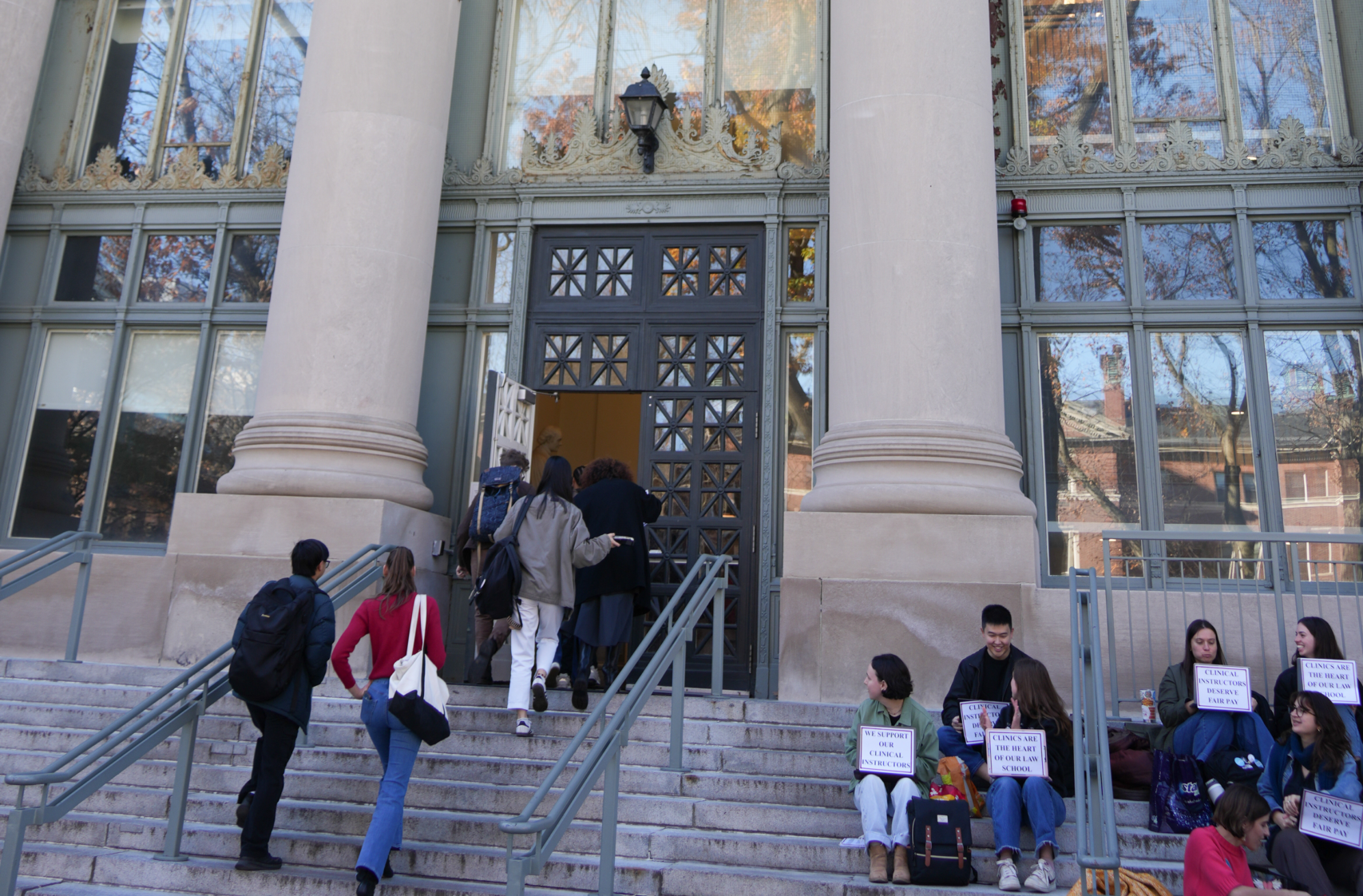
Harvard administrators photographed the IDs of Harvard Law students staging another silent study-in at Langdell Library Thursday and told a Harvard Crimson reporter covering it to leave the building. Outside, an administrator told HLS students gathered on the library steps to leave as well — less than two weeks after the Law School suspended at least 18 students from the library over a similar Nov. 6 demonstration in support of the school’s clinicians seeking a contract.
Three administrators — two in plain clothes and one wearing an HLS fleece — were accompanied by a security guard in a neon vest who said he was “on patrol.” Harvard Law Record reporters covering the study-in spoke with the administrators directly. One of the administrators in plain clothes initially declined to identify his role at the University when Record reporters asked multiple times.
During the study-in, the other administrator in plain clothes told a Crimson reporter covering the demonstration to leave the library, and the reporter left. Record staff, who are HLS students, were told they could stay because they are law students — but could not take photos inside University buildings for dissemination without prior approval from the school. Outside, Record reporters saw an administrator in plain clothes taking photos of students sitting on the library steps.
In a statement, Crimson President E. Matteo Diaz wrote, “The Crimson is committed to providing thorough and fair coverage of the University, which includes reporting on events as they unfold on campus. We stand fully behind our reporters.”
Organizers expressed shock and disapproval that a student journalist was told to leave while covering a demonstration on campus.
“It’s disgusting and disappointing,” said Silas Olsen ’28, an organizer of the study-in. “It’s just another day in this university’s consistent efforts to silence student speech on campus, even when we are simply quietly studying in a library together. The fact that a reporter from the Crimson can’t even report on a protest on our own campus is flabbergasting.”
“If The Harvard Law Record can’t report on what’s happening on the Harvard Law campus, then who can?” Olsen added. “Are these buildings going to be a black box where we don’t know what’s going on inside them? Are protests never going to have exposure?”
Another organizer, who requested anonymity for fear of disciplinary action, said: “Today, we saw an escalation of the University’s suppression of student protests, even from two years ago in the wake of Palestine protests.”
More than 20 students returned to Langdell Library on Thursday to express support for clinical instructors, who have been bargaining with Harvard for a contract since September 2024. The clinical bargaining unit represents at least 90 people who teach law students and provide legal services through the school’s in-house clinics and student practice organizations. According to the unit’s website, clinicians are seeking a “fair, transparent, and comparable pay structure” and want to “narrow the gap” between clinicians’ pay and working conditions and those of HLS faculty.
To express solidarity for clinicians, roughly 10 students studied silently at a table in the Law Library Reading Room and displayed signs reading “Clinical instructors deserve fair pay” and “HLS had a record fundraising year…and still won’t pay our CIs [clinical instructors] fairly.” The rest sat on the library steps outside — without blocking the walkway for others entering – and studied and ate with similar signs taped to their laptops.
An administrator wearing an HLS fleece told students on the steps outside that they could not protest there because it was not a designated area for protest, and told them to leave.
About 20 minutes after the study-in began, administrators started photographing participants’ school IDs. They also tried to photograph the ID of a Harvard College student who had been seated at the table before the study-in began, but stopped after she and a participant told them she was not involved.
Another administrator told a Record reporter that they intended to search the entire library for more participants.
Other students nearby said the study-in did not distract them. Rachel Yan ’28, who was studying a few tables away, said she did not notice it, though she did notice staff patrolling the library. Another HLS student, who arrived after the study-in began and walked past the table, said he noticed neither the study-in nor the patrol. Outside, he said, the students on the steps “were also silent and non-disruptive.” A third HLS student nearby also noted that students he saw participating in the study-in were “respectful, supportive, and professional.”
Organizers said the decision to hold a second study-in was partly a response to the two-week library suspensions HLS imposed after the Nov. 6 demonstration. At least 18 students received suspension letters, according to organizers, including at least two students who were not involved in the study-in. One of them, Kelsey Carido, is a Record journalist who was covering the study-in. HLS lifted her suspension Monday without explanation after she appealed.
Earlier this week, an HLS spokesperson declined to comment on how students who received suspension letters were identified. The spokesperson also declined to comment on how many appealed their suspensions and how many have been reversed.
In a statement on Thursday’s events, HLS spokesperson Scott W. Young wrote that the Law School “respects the right of every community member to speak and make their voices heard,” but that this right is “subject to time, place, and manner limitations” under University-wide policy.
Young wrote that three outdoor locations at HLS are designated for “orderly demonstrations and protests”: the Crossroads at the south end of the WCC, Holmes Field, and the Belinda Sutton Quadrangle. Absent from that list are the library steps.
“Professional photography inside Harvard Law Library, including the 4th floor reading room, is not permitted,” Young wrote.
The statement did not address why administrators photographed students’ IDs, how those photos will be used, why the Crimson reporter was told to leave, or the identities and roles of the administrators involved.
Mia Stone-Molloy ’27, a third-year student who protested outside, said her focus is the clinicians’ contract negotiations. Clinical experiences, she said, “taught me how to be a lawyer [and have] given me invaluable skills and support that I wouldn’t have gotten from any other resource here.”
Of Thursday’s events, Stone-Molloy added: “We think it’s unbelievable that they’re using these resources to suppress student speech rather than pay clinical instructors adequately.” As for events to come, she said, “We’re going to continue to be here. We’re not afraid.”
The Record will continue to follow and update this story.