News
Meet Ifeanyi and Tenzin, the 2Ls Leading Student Government
Friends since a pre-law program, the co-presidents talk falling turnout, a friendlier approach to the administration, and free tuition.
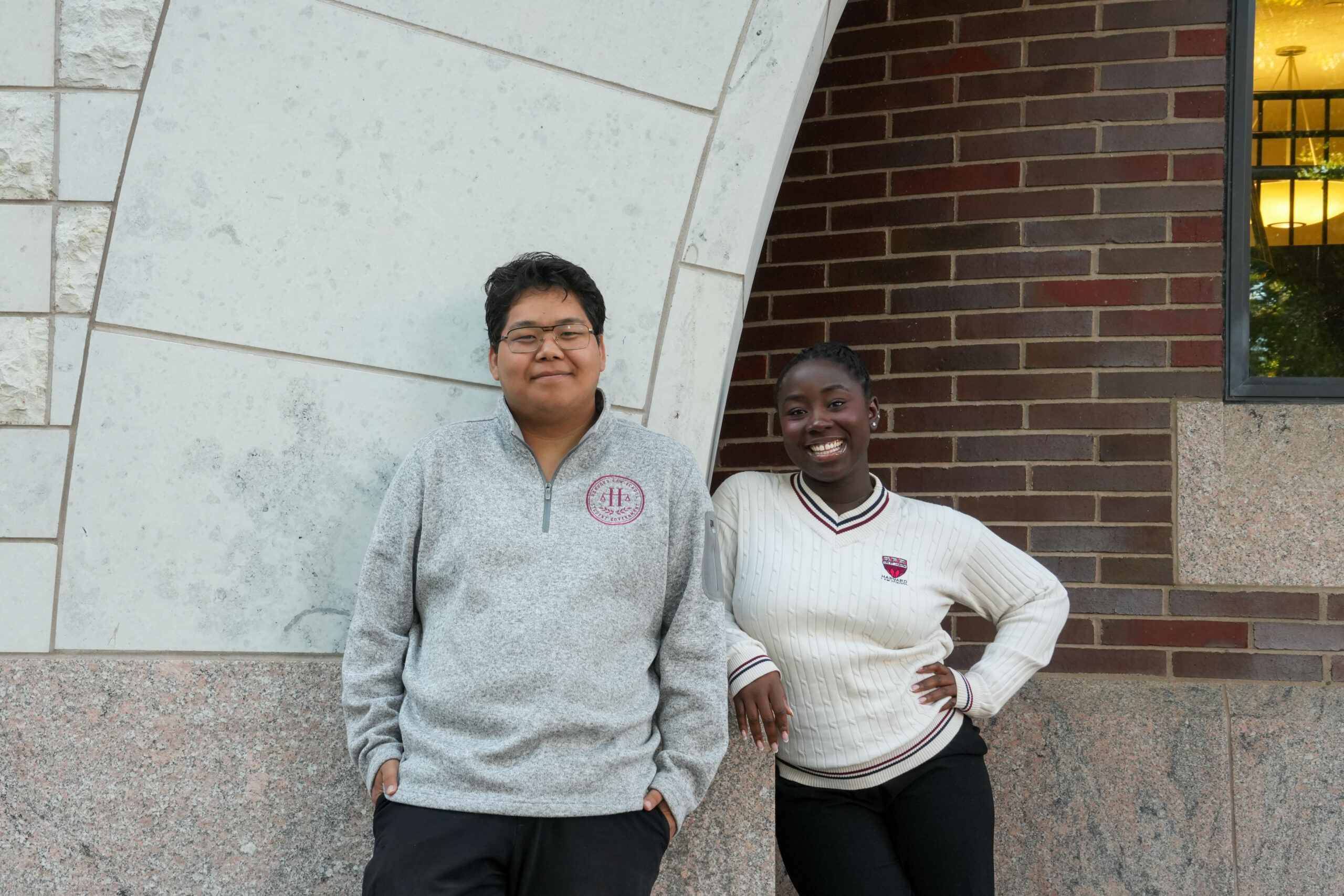
Ifeanyi R. Umunna ’28 and Tenzin Yonten ’28, co-presidents of the Harvard Law School Student Government, know students have questions about the job. Some have asked whether they were elected for life; others, whether their terms last two years. (No to both.) In an interview with the Record, they said they want to clear up that confusion by making student government more visible — while building community across the school and beyond it.
Ifeanyi and Tenzin are the first pair of 2Ls to serve as co-presidents since at least 2020, and both served as 1L section representatives last year. With most of last year’s leaders having graduated, including former co-presidents Chris Egi ’26 and Salah-Dean Satouri ’26, the two ran to preserve what Tenzin called “institutional continuity.”
Some students were surprised by the pairing. People assume the two “run in pretty different circles around campus,” Ifeanyi said. But their friendship goes back to 2022, when they met through TRIALS, a pre-law program, and both returned as teaching assistants the next year. When Ifeanyi turned 21, Tenzin, who doesn’t drink, took a shot with her anyway. And as she took a month to decide whether to run, he told her, “I’m not running without you.”
The pair ultimately won in an election that drew 531 ballots — about 27% of the law school’s student body — down from 784 last year. Asked whether voting should be mandatory, both said no. Ifeanyi said “enough is already mandatory” at HLS, adding, “I don’t personally have a punitive philosophy in general.” Tenzin noted that forced ballots invite jokes: “You’ll find people voting for a made-up candidate to be the write-in.”
Instead, they are betting that community buy-in will raise turnout. Their plans include connecting 1Ls with 3Ls, building ties with other Harvard schools and Boston-area law schools, and integrating LL.M.s and S.J.D.s. That last goal reflects a shared priority, the treatment of international students. Tenzin was born and raised in India, and both of Ifeanyi’s parents are immigrants.
Whereas last year’s co-presidents told the Record they were dissatisfied with the administration, Ifeanyi and Tenzin describe their relationship with it as “largely positive” — an approach they said they agreed on when they decided to run together. They meet weekly with the Dean of Students and recently met with the Office of Clinical Programs, the Writing Center, and the Registrar’s Office.
Tenzin, though, hopes the administration will communicate changes more clearly, citing the unannounced closure of the library’s upper floors after 7 p.m. “Nobody told us,” he said. “We had to find out just like other students.” The policy was reversed last month.
Asked what success looks like, Tenzin said he wants more students talking about student government and wanting to join in. Ifeanyi said she wants a “balanced budget” that funds events “accessible to students of all different income backgrounds.”
If they had a magic wand and could enact one policy at HLS? Ifeanyi would make printing free. Professors who restrict classroom technology to guard against AI, she said, leave students printing hunting of pages. Tenzin, on the other hand, would make tuition free.
Noting the difference in scale, Ifeanyi joked, “And that’s why there’s two of us.”